
Markets in a Minute - Emerging Markets are Back in the Game
Key Takeaways:
- Emerging markets have been driven by improving earnings, supportive policy, and shifting capital flows.
- The case for continued leadership remains intact, but risks have increased as gains have become more concentrated.
- For long-term investors, the opportunity is less about predicting the next market winner and more about building a more diversified portfolio.
As the final whistle blows on the World Cup, the familiar drumbeat of college football season is starting to grow louder. Just six Saturdays away, the usual contenders are dominating the preseason conversation. Yet every year, a few unexpected teams emerge and change the conversation, and those who bet it all on one team early in the season regret their decision. Markets often work the same way.
Emerging markets have been one of the biggest surprises of the past 18 months. Since the beginning of 2025, emerging markets have returned 60%, outperforming developed markets and the S&P 500. Yet many investors remain under allocated, leaving them on the sidelines as leadership shifted.
Emerging Markets (EM): Still Room to Run
Unlike the emerging markets of years ago, today’s EM companies are core to the global AI supply chain:
- Taiwan: Advanced chip manufacturing and packaging
- South Korea: Memory dominance
- China: Scale and integration
Together, these markets give investors access to parts of the artificial-intelligence ecosystem that are different from the familiar favorites like software, cloud, and platform businesses that dominate U.S. indexes.
Preseason favorites can generate excitement, but teams ultimately rise and fall based on what happens on the field. For emerging markets, earnings growth has been the on-field performance supporting the asset class’s success. After two consecutive years of declines, emerging markets grew earnings in 2024 and continued improving in 2025. In 2026, EM stocks are expected to grow earnings by a whopping 60%.
US vs Emerging Markets vs Developed Earnings, Actuals and Forecast
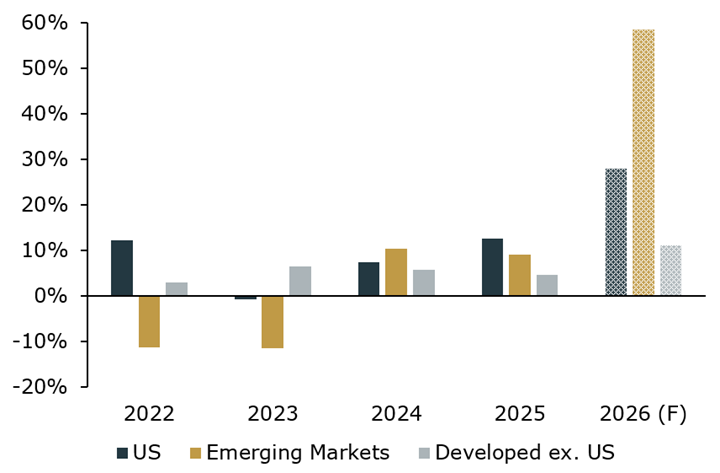
Past performance is not a reliable indicator of current or future results. Indexes are unmanaged and not subject to fees. It is not possible to invest directly in an index. Forward-looking estimates may not come to pass. Note: views are from a U.S. dollar perspective Source: Kestra Investment Management with data from Bloomberg. Index: S&P 500, MSCI Emerging Markets, and MSCI World ex. USA. Data as of June 30, 2026.
Additionally, nearly 80% of EM economies are in a manufacturing expansion, with several growing faster than the US. The manufacturing strength and breadth seen across the global economy suggests that emerging markets are in the middle of an ongoing upswing that the US is no longer leading.
Valuations provide another source of support. As of June 30, emerging markets traded at 12.3 times earnings, close to their 20-year average, while the U.S. traded near 21 times, a hefty premium to their long-term average. Those current price-to-earnings ratios put EM stocks at a 41% discount to U.S., wider than the average 27% discount over the same period. A low valuation is not, by itself, a catalyst, and emerging markets have historically traded below the U.S. for valid reasons, including political, currency, governance, and liquidity risks. Still, the current discount offers a degree of valuation support if earnings expectations hold.
What Could Slow the EM Run
Just as the U.S. market has become more concentrated in AI-related names, so too have emerging markets as a whole. Much of the recent advance in EM indexes has come from three companies in two countries: TSMC (Taiwan), Samsung (South Korea), and SK Hynix (South Korea). These two countries now account for a larger weight in the MSCI Emerging Markets index than China, the second largest economy in the world. Technology now represents roughly 45% of the emerging-markets index, compared with about 38% of the S&P 500, while the ten largest emerging-market companies account for approximately 40% of the index.
US vs Emerging Markets vs Developed Sector Composition
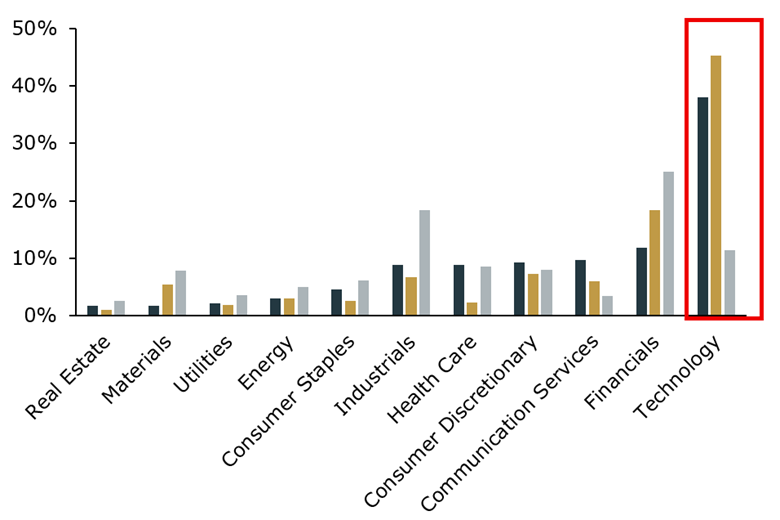
This material represents an assessment of the market environment at a specific time and is not intended to be a forecast or guarantee of future results. Source: Kestra Investment Management with data from S&P Global and MSCI. Indexes: S&P 500, MSCI Emerging Markets, MSCI World ex USA. Data as of 6/30/2026.
That concentration creates an important distinction. Emerging markets can diversify a U.S.-heavy portfolio geographically and provide exposure to different parts of the AI supply chain, but they are not independent of the AI theme. Investors should not confuse geographic diversification with complete diversification by sector or investment driver.
Additionally, the conflict in Iran has complicated the macroeconomic outlook for several emerging market countries who are highly dependent on oil imports. India, the fourth largest country in the MSCI Emerging Markets index, is a prominent example. Its long-term case remains supported by favorable demographics, manufacturing growth, and strong expected economic expansion, but they import 90% of their oil. Expensive energy has lifted inflation and can limit the ability of central banks to cut interest rates. On the flipside, an end to the conflict could act as a catalyst for oil-dependent importing countries.
No one can know whether the latest period of emerging-market leadership will last several quarters or several years. But market leadership tends to move in long cycles, and after nearly 15 years of strong U.S. performance, investors should be careful not to assume the next decade will be like the last one.
Emerging Markets / US Ratio
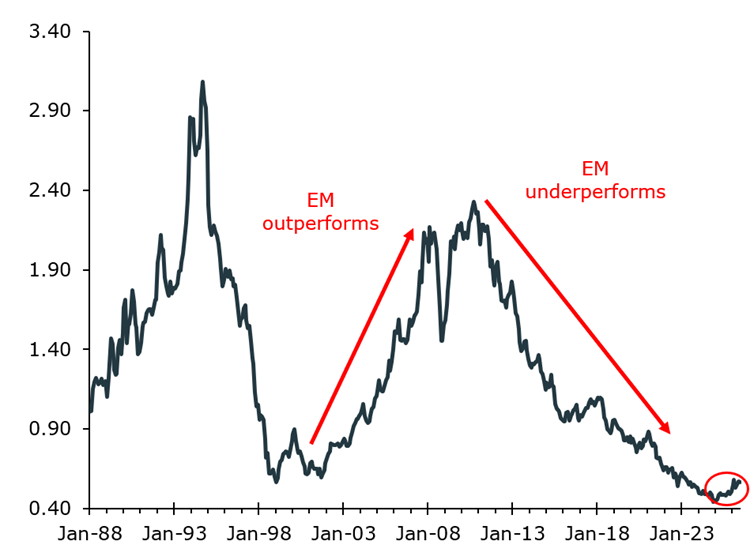
Past performance is not a reliable indicator of current or future results. Indexes are unmanaged and not subject to fees. It is not possible to invest directly in an index. Note: views are from a U.S. dollar perspective Source: Kestra Investment Management with data from FactSet. Index: S&P 500 and MSCI Emerging Markets. Data as of June 30, 2026.
What EM Can Do for your Portfolio
For long-term investors, the case for emerging markets is therefore less about predicting the next winner and more about reducing dependence on a single country, sector, or theme. A thoughtfully sized allocation can broaden exposure beyond U.S. mega-cap companies, add participation in faster-growing economies, and provide access to different parts of global supply chains.
Implementation still matters. Emerging-market indexes can be concentrated, and index providers classify countries different ways. South Korea, for example, may be treated as emerging by one provider and developed by another. Investors should understand the benchmark, country weights, sector mix, and largest holdings behind any fund they consider.
Don’t Bet the Whole Season on One Team
The United States has enjoyed a remarkable run—much like a college-football dynasty. But a sound portfolio does not need to bet everything on one team. Emerging markets can help investors participate when global leadership changes, without requiring them to predict exactly when the next surprise will arrive.
The opinions expressed in this commentary are those of the author and may not necessarily reflect those held by Kestra Advisor Services Holdings C, Inc., d/b/a Kestra Holdings, and its subsidiaries, including, but not limited to, Kestra Advisory Services, LLC, Kestra Investment Services, LLC, Kestra Private Wealth Services, and Bluespring Wealth Partners, LLC. The material is for informational purposes only. It represents an assessment of the market environment at a specific point in time and is not intended to be a forecast of future events, or a guarantee of future results. It is not guaranteed by any entity for accuracy, does not purport to be complete and is not intended to be used as a primary basis for investment decisions. It should also not be construed as advice meeting the particular investment needs of any investor. Neither the information presented nor any opinion expressed constitutes a solicitation for the purchase or sale of any security. This material was created to provide accurate and reliable information on the subjects covered but should not be regarded as a complete analysis of these subjects. It is not intended to provide specific legal, tax or other professional advice. The services of an appropriate professional should be sought regarding your individual situation. Kestra Advisor Services Holdings C, Inc., d/b/a Kestra Holdings, and its subsidiaries, including, but not limited to, Kestra Advisory Services, LLC, Kestra Investment Services, LLC, Kestra Private Wealth Services, and Bluespring Wealth Partners, LLC, do not offer tax or legal advice.